Brand, website or campaign: where do you start?
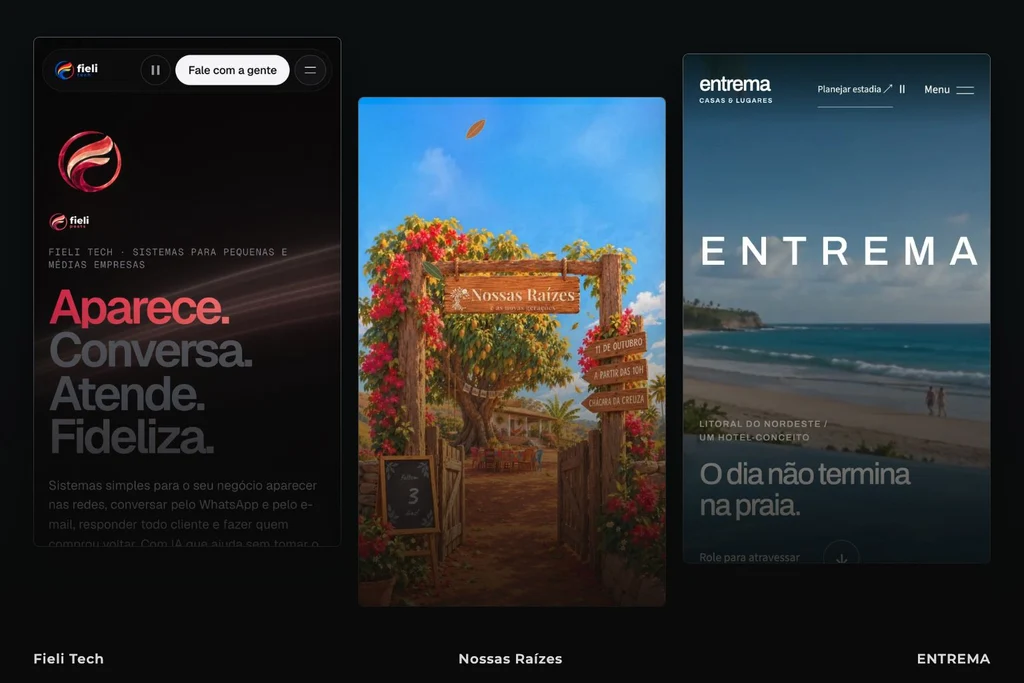
Three projects, three visual languages. Editorial composition by fieli studio using excerpts from its own projects. Nossas Raízes and ENTREMA scenes and Fieli visual elements use AI; ENTREMA is fictional.
Decide whether your next step is strategy, identity, copy or a website. Explore fieli studio projects and a practical outline for your first conversation.
By fieli studio
In 30 seconds
- A creative studio turns a challenge into decisions about strategy, identity, language and experience. A project may address one area or connect several.
- At fieli studio, the scope starts with what needs to change and what deserves to stay. Industry and website type do not define our boundaries; capacity, context and responsibility guide each decision.
- Three projects show different applications: the Fieli family, the pro-bono family project Nossas Raízes and the fictional hotel ENTREMA. A practical outline helps you prepare the first conversation.
Imagine someone is referred to your business. They open your profile, visit your website and still have to ask what, exactly, you deliver. Another company can explain its offer clearly, but its presentation has not kept up with its growth. A third has a new idea and no defined way to bring it into the world.
All three might ask for a website. Each needs a different conversation.
fieli studio is a creative studio working across strategy, brand, language, digital and launch. Our role is to turn the challenge into a coherent project: understand what must change, decide what to preserve and build the parts it needs. This article explains what those areas deliver, how they connect and how to choose a starting point.
Start with the change you need to make
Before a list of services comes a question: what does someone need to understand or be able to do that is not happening today?
Perhaps your work has changed while people still associate the brand with an older offer. Perhaps your website has beautiful images but does not explain the service. Or a launch may depend on a name, message, identity and page working together. Each situation calls for a sequence of decisions.
Understanding and defining a problem before developing solutions is a principle in the Design Council’s Double Diamond. We use that reference to explain the value of investigation; how a project is run depends on its context.1
This is the Studio’s starting map for making the conversation concrete. It is not an automatic assessment. It organises hypotheses that still need to be checked.
On a phone, swipe the table to compare its three columns.
| What you notice | What we need to investigate | A possible deliverable |
|---|---|---|
| People understand something different about your business | Offer, audience, message and existing associations | Positioning and a messaging structure |
| Each piece looks as if it belongs to a different company | Identity, applications and usage rules | A visual system and application guidance |
| The website requires repeated explanations from your team | Information, navigation, language and next steps | Reorganised content and digital experience |
| You have something to launch, but the pieces do not connect | Central idea, sequence and campaign destinations | Concept, copy, art direction and defined materials |
| A gathering or story needs people to take part | Audience, context of use and ways to contribute | A distinct identity and digital experience |
This helps avoid rebuilding what already works or producing a new piece for a problem that remains undefined.
What each area can deliver
Strategy: choose what the brand will stand for
Strategy sets the choices that guide the work: who the project serves, what it offers, which difference it can demonstrate and what perception it wants to build. It may involve research, positioning, brand architecture and communication priorities.
A useful deliverable provides criteria. When a team chooses between two messages, it should be able to explain which better represents the offer. A polished presentation that cannot help with that decision has left work unfinished.
If positioning is already clear and documented, we can work from it. Reviewing an identity does not require pretending the business is starting again.
Brand: build recognition across applications
Visual identity may include a symbol, signature, typography, colour, composition, image direction and motion. The system needs to work wherever it will be used: on a phone, in a proposal, on signage or in a campaign, according to the agreed scope.
The test does not end when the logo looks right in the middle of a screen. We need to check whether the identity can be applied consistently in less comfortable conditions too: limited space, long copy or a photograph sharing attention with information.
We also agree on the files, guidance and applications to be delivered. Naming, a complete identity system and a focused adjustment are different assignments. The proposal should make that distinction clear.
Language: make the message hold together
Language defines what to say, in what order and in which voice. Deliverables may include messaging, verbal identity, website copy, campaign headlines and tone guidance. Portuguese, English and Spanish each require attention to their readers, beyond substituting words.
Consider a page’s button. “Learn more” can obscure what happens next; a label naming the destination helps someone decide. Nielsen Norman Group describes how wording, context and previous experience shape expectations about a link.2 It is a small example of a larger point: copy is part of how an experience works.
A strong line must survive outside a studio presentation. It needs to remain true when the sales team uses it and when a customer encounters the service.
Digital: turn the promise into something people can use
On a website, the decisions meet. Identity gives shape, copy guides, navigation organises and implementation makes the experience work across screens and conditions.
A digital project may include information architecture, interface design, content, development, publication and measurement setup, as agreed. Integrations, restricted areas, third-party systems and maintenance need their own definition. They are not automatically included in the word “website”.
Starting with mobile helps expose priorities: what must appear first, what can wait and which action needs to be clear. The same care applies to keyboard use, readability, images and responsiveness.
Launch: prepare the encounter with the audience
A launch may need a concept, art direction, social assets, presentation, film or dedicated page. The choice follows what needs to be communicated and where the conversation will continue.
The work includes checking how those pieces connect. If an ad promises a resource, its destination must provide it. If a caption invites a conversation, it should be clear what that conversation is about. Paid media, audiovisual production, recurring operation and follow-up belong in the scope when agreed, with responsibilities and costs defined.
These five areas can connect in a complete project or address a focused need. Commissioning a website does not oblige you to rebuild the whole brand.
Three projects show why the form is not predetermined
In the Studio’s selected work, three projects reveal different decisions. They demonstrate conception and execution. We do not present commercial outcomes that have not been measured.
Fieli Tech: a recognisable family. Its branding and websites need to distinguish several solutions while preserving their relationship. Shared geometry, colours and product language organise that family. This is our own company’s work; the applications are in development. The presentation demonstrates branding and digital presence, rather than proving every feature is commercially available. Explore Fieli Tech.
Nossas Raízes: an identity that invites participation. In this real, pro-bono family project, generations become a tree, a tone of voice and an album. The invitation to gather photographs becomes part of the story. Its priorities are memory, participation and belonging. See the public excerpt in the Studio’s presentation of Nossas Raízes; this article does not expose the family’s personal archive.
ENTREMA: an experience shaped by choices. In the fictional hotel, the relationship between sea and table guides imagery, spaces, narrative and navigation. Visitors explore a house, save an experience and carry their choices into a stay notebook. It is an evolving concept with AI-generated imagery and no real reservations. Explore ENTREMA.

The same studio signs the work. Its judgement carries across projects; the appearance responds to each context. Hospitality, healthcare and events can feature in our portfolio without defining a boundary around whom we work with. Capacity and fit with the challenge guide new projects.
What needs to be agreed before work begins
The first contact can be a message explaining the challenge and what exists already. That conversation helps establish context and whether it makes sense to move forward. Assessment, creation and implementation receive defined scopes. Sending a message does not commission or automatically include every stage.
A few decisions should be explicit:
- Deliverables and boundaries: which pages, copy, applications and files belong to the assignment, and which depend on another workstream.
- Material and approval: who supplies information, consolidates feedback and decides for the company. Conflicting feedback needs resolution before it becomes endless revision.
- Milestones and dependencies: what will be presented at each stage and what needs to be available to proceed. A desired date does not remove dependencies on content or access.
- Use and continuity: files and rights under the agreement, third-party licences, access and responsibility for keeping information current.
- Investment: creation, production, integrations and follow-up explained separately. Page count alone does not describe complexity.
This agreement protects the attention devoted to the work. Taking on a few clients at a time requires choosing the schedule responsibly, even when a challenge is interesting.
If your immediate need is a hotel website, our briefing guide explores the information to gather. If the question concerns existing imagery, the note on photography and website presentation helps assess material before commissioning another shoot.
How to check whether the project is addressing the problem
Before discussing reach or sales, check whether the work delivers what was agreed. Is the message understandable? Does the identity hold across applications? Can someone find information and complete the task? Does the published website match the approved content?
Then choose measures appropriate to the objective: relevant search queries, attributed visits, confirmed form submissions, conversations with an actual need, proposals and contracts. One stage does not substitute for another. A WhatsApp click, for instance, does not prove that a message was received.
We make the same distinction with content and search. Sources and structure help, but an article must contribute something worth reading. This is consistent with Google’s guidance on useful, reliable content.3 SEO, links and metadata are part of the preparation. They are not promises of rankings or citations by AI assistants.
Other websites link to work or content when they find a reason to reference it. Publishing an article does not automatically create backlinks. Our responsibility is to make the source clear, useful and verifiable, without manufacturing recommendations or results.
An outline for bringing us your challenge
Before the first conversation, organise three columns: preserve, address and create. Put what you can already identify in each. This simple map helps separate a wish for novelty from a project need.
Then answer:
- What has changed in the business, or what is beginning now?
- Who needs to understand that change or take part?
- What already works and deserves to stay?
- Where do people become confused, stop or ask for an explanation?
- What should they be able to do after the project?
- Which deadlines, materials and decision-makers are already identified?
Download the text outline to complete. It is available to read and fill in without a form or registration. “I do not know yet” can also reveal a decision worth discussing.
Bring an idea, an existing brand or something you cannot yet name. Tell us what needs to change. That is where the conversation starts.
Frequently asked questions
What does a creative studio do?
It connects decisions about strategy, identity, language and experience to shape a project. Deliverables may include branding, copy, a website and launch materials. The scope depends on the challenge; you do not have to commission every discipline.
Can I commission just a website or a visual identity?
Yes. A project can focus on one of those areas. First, we need to understand existing material, dependencies and who will supply the necessary information. The aim is a workable scope, without adding services by habit.
Does fieli studio work only in hospitality?
No. Hospitality is one context in which we demonstrate our work. We consider different industries and project types according to capacity and fit with the challenge. Our initial constraint is how many clients we can support with care.
What should I send to start a conversation?
Explain what has changed or needs to be created, who the project is for, what already exists and any relevant deadline. A link to your current website, brand or material helps. You do not need a perfect brief to get in touch.
Sources
- Design Council — The Double Diamond (Accessed 8 October 2026)
- Nielsen Norman Group — Information Scent (Accessed 8 October 2026)
- Google Search Central — Creating Helpful, Reliable, People-First Content (Accessed 8 October 2026)
Updated .
How we made this note: AI-assisted research, every source opened and checked, writing and review by fieli studio.