
Do you need a website if clients already come through referrals?
AI-generated conceptual composition. Not real client documents or evidence of business results.
Already winning clients through referrals? Find out when a website earns its place and use five questions to review what people find after hearing your name.
By Karl Belowodski · fieli studio
In 30 seconds
- A referral can create interest while leaving practical questions unanswered.
- A website earns its place when it organizes information that is scattered or repeatedly explained in person.
- Check identity, services, fit, work and contact. Use the findings to choose a proportionate next step.
“You should talk to this company. They do good work.”
That is a useful introduction. It might arrive with a name, a social profile or a phone number. It may not say whether the business serves your area, handles the kind of project you have in mind or offers the level of support you need.
If referrals already bring you clients, the website question starts with what people need to know after hearing your name.
A business that works well does not automatically need a complex digital operation. It may need a clear place for information that otherwise has to be explained from scratch. The five-question map below helps you decide what that place should contain.
An introduction leaves room for questions
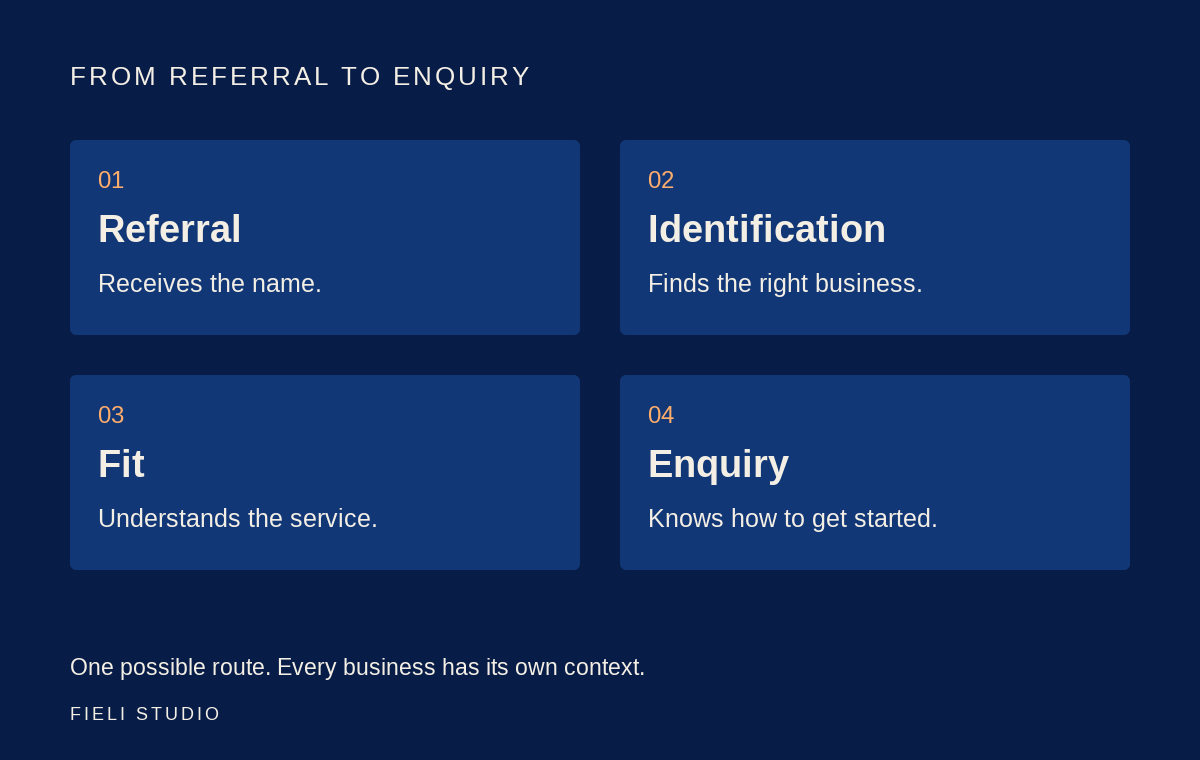
Consider someone looking for an interior design practice. A friend recommends the team that renovated their home. The new project is a small shop. The prospective client looks up the practice to find out whether it takes on commercial work, where it operates and how an engagement begins.
This is an illustrative scenario, not a measured journey through your business. The distinction matters: the recommendation concerns a previous experience; the next buyer needs to establish fit for a different brief.
In its research on corporate information, Nielsen Norman Group observed participants consulting both company websites and outside sources to form an opinion. Published in 2019, that usability research is not a current measure of every buyer’s behaviour. It does support making company information clear and consistent.1
A referral can also include a link to a relevant project. That gives the recipient something specific to examine and the person making the introduction a way to explain it. The work shown should reflect your current offer and have permission for public use.
When buyers compare options, what can they find?
There are two tasks: locating the right business and finding enough information to consider it.
Similar business names, disconnected profiles or conflicting contact details can complicate the first task. A consistent name, a domain and links between your channels help organize your presence. They do not secure a search position. Google explains that the site name displayed in results is generated automatically using multiple signals.2
The second task relies on content. A buyer might need to understand your services, the people responsible, your process and relevant work. You do not have to criticize another supplier to make your offer understandable.
Search for your business as if you had never spoken to the team. Open the result you would be most likely to choose. Is the answer there? Treat this as one observation, shaped by the search context, rather than a full visibility audit.
Give lasting information a place of its own
Imagine an event company that has shared two years of projects on social media. A new visitor may see the latest celebration without knowing whether the company handles corporate events, provides catering or operates only at one venue.
A website can arrange those answers by service or event type, with authorized images, scope and an enquiry route. Social media still has a role in showing recent activity. The website gives people a way to find information without depending on when it was posted.
The same principle applies to a technical consultancy. A post can introduce a project; a service page can explain when the service is relevant and what the engagement includes. NN/g’s homepage guidance recommends communicating the offer, providing examples and directing users to useful actions.3
Modern design serves those tasks through hierarchy, typography, imagery and navigation. Animation cannot stand in for an answer. Our article on the journey from Instagram to a website explores how those channels can work together.
Start with the scope your business needs
A one-page website may be enough for a straightforward service, a few relevant examples and one clear enquiry route. It should explain the offer, who it serves, who does the work and how to get started.
Separate pages become useful when services involve different scopes, projects need context or distinct audiences have different questions. Adding pages simply to make a site larger does not necessarily make it easier to use.
Postponing a larger project can also be a reasonable decision. If people find what they need, enquiries are handled well and delivery capacity is the immediate priority, a complex website may not be the next investment. Look for a specific gap: repeatedly explaining the same service, correcting conflicting information or struggling to present an important area of work.
Before requesting a proposal, describe that gap. “Our commercial projects are hard to find” is a clearer starting point than “we need something modern.” For a broader view, see where to begin with a brand, website or campaign.
A five-question presence map
Choose one service and follow the route on your phone. Record where each answer appears. If you need help from the team, note that dependency. This is a working checklist, not a quality score or a forecast of sales.
Open the five-question map at the end of this page. Each item includes a question, an action and a way to check it.
Download the CSV worksheet to complete with your team. No registration is required. If you do not have a website, use the channels you have and identify information that is missing or spread across them.
Ask someone unfamiliar with the materials to find the same answers. Avoid guiding them through the task. One person does not represent your whole audience, but the attempt may reveal an unclear label or something you know so well that you forgot to explain it.
Make the information useful, then keep it current
For each gap, agree who provides the information, who approves it and who maintains it. An outdated phone number remains a problem in a beautifully designed page.
To assess changes, follow visits, actual enquiries and the context of opportunities over time. A contact-button click does not establish that a message was sent. Asking people how they found you and what they looked at can add context without pretending to reconstruct every step.
Google’s SEO Starter Guide recommends organizing content so people and search engines can understand it. It also makes clear that indexing and top rankings are not guaranteed.4 The page still needs to be useful to someone arriving through a link in an email.
If people already recommend your business, there is a reason. Give the next person a way to discover it without starting from scratch.
Five-question business presence map
Follow the route available today. Record what you find and what needs work.
Can someone identify the right business?
Compare the business name, website address, profiles and contact details.
How to check Where does this answer appear? What is still missing?
Is the service explained?
Look for deliverables and an explanation of how an engagement begins.
How to check Where does this answer appear? What is still missing?
Can they tell whether you fit their needs?
Check audiences, service area and scope boundaries.
How to check Where does this answer appear? What is still missing?
Can they examine your work?
Open an authorized project, labelled example or explanation of your process.
How to check Where does this answer appear? What is still missing?
Does the next step work?
Test the contact link without sending an unsolicited test enquiry.
How to check Where does this answer appear? What is still missing?
Frequently asked questions
Does every referral-led business need a website?
Not necessarily. Consider the information buyers need, the channels already in place, budget and who will keep the content current. The map helps identify a concrete need.
Can a one-page website be enough?
Yes, for a straightforward offer with clear information and a simple next step. Different services or detailed projects may warrant their own pages.
Should a website replace social media?
It does not have to. A website can organize durable information while social channels carry updates and conversations.
Will a website put my business first in Google?
No. Publishing, indexing, appearing for a query and winning a client are different events. Neither a position nor a sale is guaranteed.
Sources
- Nielsen Norman Group — About Us information (Accessed October 17, 2026)
- Google Search Central — Site names (Accessed October 17, 2026)
- Nielsen Norman Group — Homepage design principles (Accessed October 17, 2026)
- Google Search Central — SEO starter guide (Accessed October 17, 2026)
Updated .
How we made this note: AI-assisted research, every source opened and checked, writing and review by fieli studio.