Before the layout: a brief for your hotel website
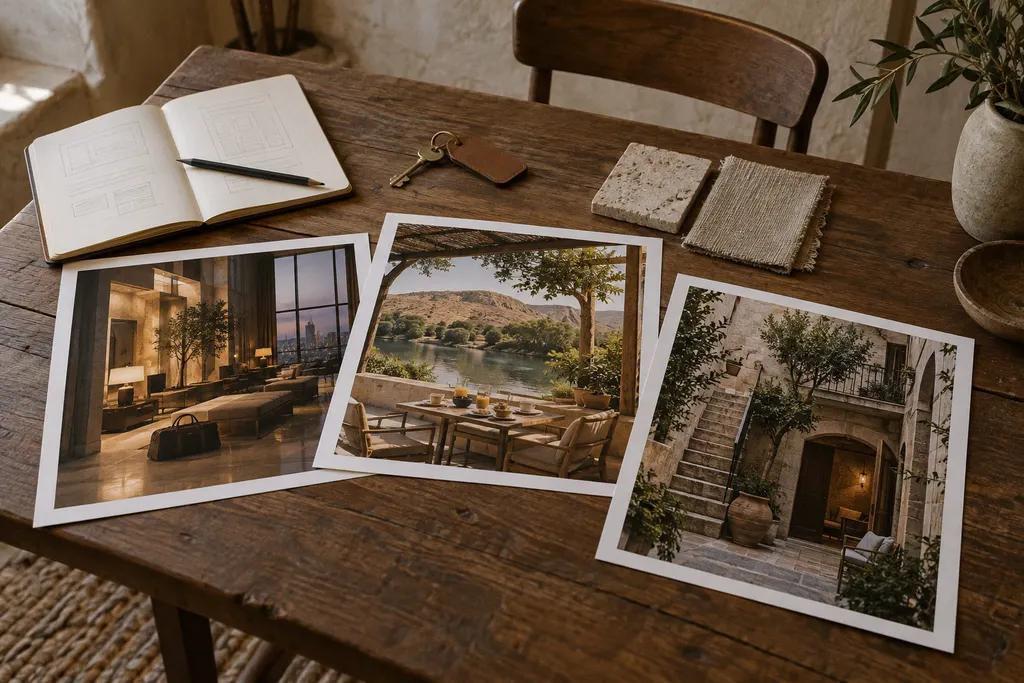
Before choosing a screen, gather what the place has to say. Illustrative image created with AI.
Turn your hotel's identity into decisions about copy, photography and booking. A website briefing guide with three examples and five practical decisions.
By Karl Belowodski · fieli studio
In 30 seconds
- A website brief explains who the hotel welcomes, what the stay offers and what evidence supports it. Visual references follow those decisions.
- A recognisable identity and familiar navigation can coexist: guests should understand the place without relearning how to find rooms, terms and booking.
- Three fictional hotels show why different operations need different priorities. Five practical decisions and a one-page outline help you prepare the website conversation.
A new website can start with the wrong question
“We want a more modern website.” That opens a conversation, but it does not yet guide a project. Two guesthouses might agree on a typeface, large photographs and an opening video while attracting guests for completely different reasons.
A hotel website brief makes those differences explicit. It brings together the decisions a project must respect: who the hotel wants to welcome, what the stay offers, which information supports that promise and how someone reaches a booking. It can start on a single page. It need not be a fifty-slide presentation.
In Every hotel website is the same website, we discussed why so many pages end up looking alike. Here we take the next step: preparing a conversation that gives a designer something more precise than a folder of admired websites.
The opening question I propose is: what experience does this hotel want guests to understand before they arrive?
What should remain familiar?
Finding rooms, understanding the terms and making a booking are tasks. Guests should not have to decode a new language to carry them out.
Nielsen Norman Group recommends building on what people already know from other interfaces. The W3C’s guidance on consistent navigation also calls for predictability across pages within a set. These are principles for making a site easier to use, not instructions to copy every hotel’s appearance.1, 4
A menu labelled “Rooms” can be clear on thousands of websites. What comes after it should explain this hotel’s reality: differences between categories, views, access and what is included. The route can be familiar while content and presentation express the property’s identity.
The same applies to the platform. Before replacing a tool, find out what it lets you reorganise. A shared feature can support booking while a distinct content direction shapes the rest of the experience.
Three hotels, three possible openings
The following scenarios are entirely fictional. They do not describe Studio clients or project results. They show how differences in the operation change a website’s priorities.
An urban hotel welcoming late arrivals. A visitor may be choosing where to sleep between meetings. An opening that shows the entrance at night, explains how to get there and clarifies reception arrangements could be more useful than leading with the pool. Publish opening hours only when the operation can deliver them.
A riverside inn connected to early excursions. A breakfast table overlooking the landscape can introduce the stay, but the information must continue: when is breakfast served, where do trips depart, what depends on an outside operator and what is included in the room rate? The site needs to distinguish the inn’s offer from activities booked separately.
A historic guesthouse with rooms on different levels. Its staircase may be part of its character. It also affects access. Showing the route, describing levels and answering mobility questions accurately are acts of hospitality. Images should help guests choose a room, without concealing an important condition for the sake of aesthetics.

All three places can use familiar menu labels and a conventional calendar. Their opening story, information order and photographic needs will differ. Those differences belong in the brief before they become a layout.
Bring evidence as well as visual references
A visual reference helps discuss pace, contrast and photography. On its own, it does not explain why someone would choose your hotel.
For each proposed strength, I suggest gathering three things: the fact, its evidence and its relevance to the guest. This is a Studio working tool, not a scientific quality score.
“We serve regional food” is still broad. If the operation supports it, the brief can specify breakfast dishes, where ingredients come from and what changes with the seasons. A table photograph and a precise description then have a job to do. Without those facts, a designer is left with an adjective to illustrate.
The same care applies to identity. A newly chosen colour does not become recognisable overnight. The Ehrenberg-Bass Institute assesses distinctive brand assets through recognition and association with a brand. Consistent use and evaluation are part of the work.3
The brief should therefore record what already has value: a shape, an expression, a material or a photographic approach. A refresh need not erase everything to show that something has changed.
Every photograph should answer a question
Choosing images for beauty alone can leave a decisive question unanswered. Is the balcony private? Which room category is shown? Are there steps on the way to the room? Is that view available from every room or only some?
A useful photography brief links each scene to the information it must provide. It might request an overall room view, a service detail and an image of the access route, rather than three almost identical shots of the bed. It should also address portrait crops, usage rights and anything that no longer reflects the operation.
Copy supports that choice. Clear labels help visitors anticipate what they will find when they follow a link, one of the points in Nielsen Norman Group’s work on information scent.2 An image and its caption should make the place easier to understand together.
Before commissioning another shoot, read our note on helping your website make better use of existing photographs. Sometimes the first gap lies in selecting and presenting material you already have.
Booking belongs in the brief too
The project needs to describe what happens after the button. Do guests stay on the site or open another platform? Do room category names match? Can they understand dates, occupancy, prices and conditions? Do they know how to ask for help?
An external booking engine is not a problem in itself. What matters is checking the actual mobile journey and agreeing on responsibilities: what the Studio can change, what depends on a supplier and what the hotel team must keep accurate.
Languages belong in the same conversation. A Spanish introduction loses continuity if essential information or confirmation subsequently requires Portuguese. Google recommends separate URLs for language versions and visible content in the corresponding language; this supports their organisation but does not guarantee search positions.6 Our note on welcoming guests in Spanish explores that journey further.
Agree on measurement as well. An article visit, an availability search, a WhatsApp click and a confirmed booking are different stages. Defining what each tool records helps prevent promises the measurement cannot substantiate.
A one-page brief to start the conversation
You can copy and complete this outline before the first conversation. It is a Studio proposal, not an automatic assessment or a questionnaire that replaces listening to the operation.
- Who we want to serve better: a priority type of stay and the need behind it.
- What guests will find: three facts the team can confirm, supported by images or other evidence.
- What they need to understand before booking: recurring questions, conditions and limits of the experience.
- What the brand should preserve: elements used consistently and what still needs development.
- The next step: check availability, book or start a conversation, with a clear destination and owner.
- Who maintains each piece of information: responsibility for opening hours, categories, conditions, images and language versions.
An honest “we do not know yet” is useful. It identifies a decision that needs to be made before asking a layout to solve it.
Who keeps the promise after launch?
When copy offers an experience, the operation must deliver it. When information changes, someone needs to update how it is presented.
A hotel that can only review its site monthly should not depend on a daily programme on its opening screen. Choose content the team can keep accurate. That decision affects the design, the update system and the ongoing cost.
Original, verifiable information also helps create useful content for people searching. This is consistent with Google’s guidance on helpful content; it is neither an SEO shortcut nor a promise of citations from AI assistants.5
A good brief lets you review a screen against criteria: does it show what we agreed? Does it answer the right question? Does it preserve something recognisable? Is the next step clear? Can the team maintain it?
The work starts to belong to the hotel when those answers no longer fit every other property. That is when the layout has a direction to follow.
Five decisions to bring to the brief
You do not need to arrive with a finished website design. Bring decisions that can be discussed and checked.
Choose a priority situation for the stay.
Pick a concrete need the hotel wants to serve better: a late arrival, a weekend for two, a work trip, a family stay or an itinerary of excursions. It guides information priorities without excluding other guests.
How to check Can the team finish this sentence: this person chooses our hotel because they need…?
Gather three pieces of evidence of the place's character.
They might be a photograph of a particular room, the origin of an ingredient or a real service detail. Evidence must match what guests will find, rather than just a brand aspiration.
How to check Does each claimed strength have an image, a verifiable fact or an established practice the team can show?
Bring the questions people ask before booking.
Collect recurring topics about access, opening times, room categories, food and conditions. Summarise the themes and remove names and personal details from conversations.
How to check Which three questions does reception answer repeatedly that the website could address?
Agree on the journey through to confirmation.
Decide where guests check dates and prices, who handles questions and what happens when booking opens on another platform. Photography and identity must work alongside clear information.
How to check On a phone, can someone explain the next step on each screen without asking the team for help?
Assign responsibility for information that changes.
Opening times, policies, room photographs and services need someone to check and update them. Choose a routine the operation can sustain before promising a website that changes every week.
How to check If breakfast hours change tomorrow, do we know who updates the website and the other channels?
Frequently asked questions
What is a hotel website brief?
It is a decision document that guides the project: priority audience, the experience offered, supporting evidence, guest questions, the booking journey and responsibility for updates. It can start on one page and develop during the assessment.
Does using another hotel's platform make the websites identical?
Not necessarily. A platform can provide shared technical features while content, hierarchy, imagery and language express each hotel. Its actual limitations should be assessed before deciding what to customise or replace.
Do I need a new photo shoot before commissioning the website?
Not as a rule. First, take stock of existing images, confirm usage rights and identify the information they fail to show. A photography brief can then address those gaps with specific scenes and crops.
Does the booking engine need to be built from scratch?
No. An existing engine may serve the project well. Assess its mobile experience, languages, the conditions it displays and continuity of the journey. A distinctive appearance does not require rebuilding a tool that already supports the operation.
Does this guarantee more bookings or a position on Google?
No. A brief clarifies decisions and review criteria. Results also depend on demand, the offer, pricing, availability, distribution and execution. Search performance, navigation and contact actions need to be measured after publication.
Sources
- Nielsen Norman Group — Fresh vs. Familiar: How Aggressively to Redesign (Accessed 7 October 2026)
- Nielsen Norman Group — Information Scent: How Users Decide Where to Go Next (2 February 2020; accessed 7 October 2026)
- Ehrenberg-Bass Institute — Distinctive Asset Measurement (Accessed 7 October 2026)
- W3C — WCAG 2.2: Understanding Consistent Navigation (Accessed 7 October 2026)
- Google Search Central — Creating Helpful, Reliable, People-First Content (Accessed 7 October 2026)
- Google Search Central — Managing Multi-Regional and Multilingual Sites (Accessed 7 October 2026)
Updated .
How we made this note: AI-assisted research, every source opened and checked, writing and review by fieli studio.